Ainu N.O.S. Indigenous People
Soon available
Limited Edition
Limited Edition
1,643 fountain pens
Nib
Nib
14kt white gold, or steel
Filling system
Filling system
cartridge/converter

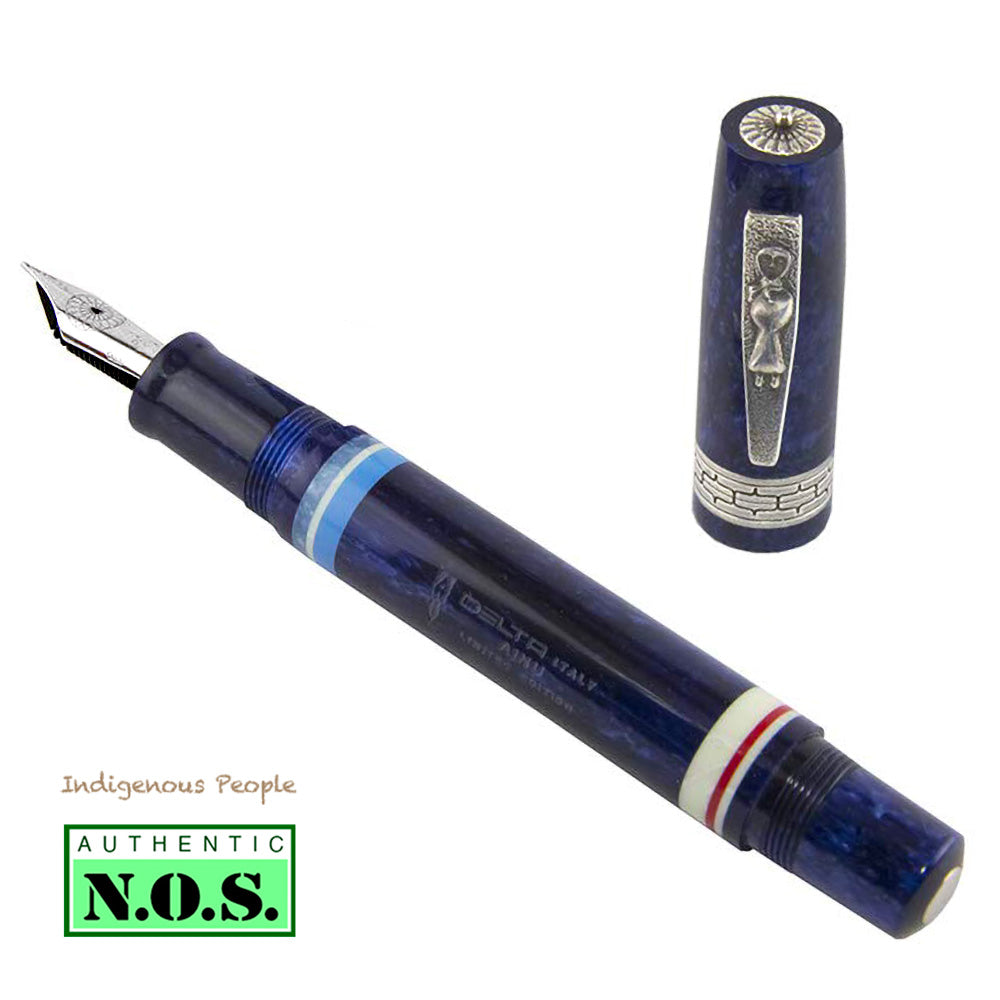
The Delta Ainu N.O.S. fountain pen, from the Indigenous People series, was made in 2005 with dark blue mother-of-pearl resin, hand-turned from solid bar, interspersed with multi-colored resin rings and solid silver details.
The pens for sale here are N.O.S. (New Old Stock): never used, never sold or displayed, but kept in Delta's warehouse since 2005. Delta has reassembled and overhauled them, equipping them with a new 14Kt gold nib (or steel), both customized with the original decoration.
Continue ▷
- Dark blue mother-of-pearl resin body, hand-turned from solid bar
- Multi-colored resin rings along the profile
- Cap band and cap top disc in 925‰ solid silver, relief engraved
- Steel or 14Kt gold nib, decorated with original Ainu motif
- Interchangeable nib, compatible with standard converter
- Cartridge or converter filling system
Try it with Iroshizuku yama-budo (dark red purple) to enhance the deep tones of the resin, or with J. Herbin Larmes de cassis (dark red purple) for a consistent color combination with the pen's character.
The Ainu fountain pen
The body of the Delta Ainu N.O.S. Indigenous People fountain pen is made of dark blue mother-of-pearl resin, hand-turned from a solid bar, with multi-colored resin rings marking its profile. At the end of the cap, there is a relief-engraved 925‰ solid silver band, similar to the disc at the top of the cap.
The steel or 14Kt gold nib — both decorated with the original Ainu motif — is interchangeable and compatible with a standard converter. The pen can be filled with cartridges or a converter.
The Ainu people and the Indigenous People collection
"Ainu" means "human." The Ainu people believe that all living beings and natural phenomena — animals, fire, water, wind — are deities, for whom prayers or rituals are performed in daily life. The word "Ainu" refers instead to everything that is not a god.
The Ainu live in Hokkaido, the northernmost island of the Japanese archipelago. They are about 15,000 individuals of Europoid origin, with fair skin, wavy black hair, and brown eyes, who traditionally lived by hunting, fishing, and gathering. It is not known with certainty whether they descend from a Mongol or Caucasian population that landed on this island about 25,000–30,000 years ago.
Having no written language, they transmit stories, legends, and moral rules orally from generation to generation. Ainu history and tradition are entrusted to narrative prose and epic poetry; melodies are built on two or three notes and often imitate the sounds of animals or birdsongs.
The first Westerner to come into contact with them was the Dutch sailor Maerten Vries, during his 1643 voyage along the northern coasts of Japan, during which the first map of those regions was drawn.
In 1868, with the Meiji Restoration, Hokkaido became an integral part of Japan. A process of colonization began that transformed Ainu culture: the Japanese, attracted by those pristine lands, gradually settled there. In 1872, the Ainu were enumerated as Kyodojin (aborigines). Despite the assimilation policy, they have maintained their identity as an indigenous people — "an unspoiled people frozen at the dawn of history."
FAQ
What does N.O.S. mean and why is it relevant to the Ainu Indigenous People?
N.O.S. stands for New Old Stock: products manufactured and never entered into the commercial circuit, kept intact by the manufacturer. The Delta Ainu pens for sale on pens.it have remained in Delta's warehouse since 2005 without ever being sold or used.
Is the Delta Ainu part of a larger collection?
Yes. The Ainu belongs to Delta's Indigenous People series, one of the most appreciated thematic collections of the Neapolitan brand, dedicated to the indigenous peoples of the world. Other models from the same series are available on pens.it: the Sentinelesi and the Simbu.
How many units are still available?
The Delta Ainu Indigenous People is a limited series from 2005, no longer in production and sold out for many years. The available units come directly from the original Delta stock.
The Ainu version for sale has cartridge/converter filling.
Ainu was originally produced in 3 versions:
- 1K with silver trim and converter filling;
- 1KS with vermeil trim and lateral lever filling;
- Celebration, with vermeil trim, brilliant-cut stone on the cap top, and lateral lever filling.
The Delta NOS Indigenous People Ainu pen is packaged in a standard box – the original custom boxes have not been found.
The listed price has been updated from 21 years ago.
Both the nib and the disc at the top of the cap are decorated with the same design representing the characteristic pendant of an Ainu necklace, the "tamasay".
The clip is engraved in bas-relief with the three-dimensional image of the "nipopo", a good luck wooden doll.
The Ainu people
The Ainu, meaning "human," is the name of a people of Europoid origin, of Mongol or Caucasian race, who settled on the Japanese island of Hokkaido approximately 25,000-30,000 years ago.
Lacking a written language, the Ainu transmit stories, legends, and moral rules orally from generation to generation. Their songs are melodies consisting of only two or three different notes and in many cases imitate animal sounds or bird calls.
In 1997, a new law provided funds for the research and promotion of Ainu culture, such as their language, traditional dances, and various ceremonies.
The Ainu pens are all sold out, except for the few models available for purchase here.
Dicono di noi
Conosci il programma Fidelity?
Accumula credito ad ogni acquisto e spendilo come vuoi.
Scopri come funziona →- Choosing a selection results in a full page refresh.
- Opens in a new window.